This is what your search history might look like if you’re writing a vampire novel.

Please don’t send the Feds.
Home of the works by KM Smith
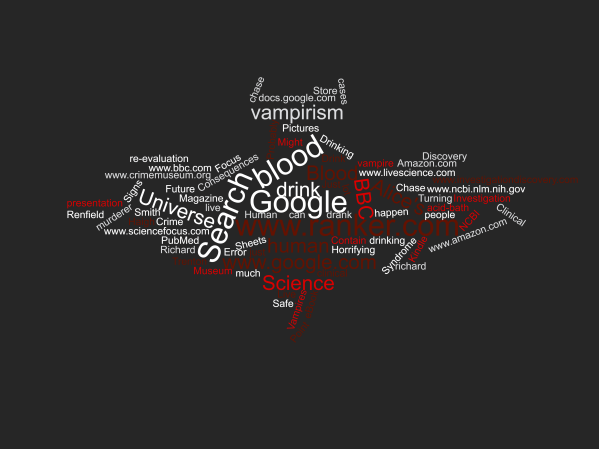
This is what your search history might look like if you’re writing a vampire novel.
Please don’t send the Feds.

Dear readers, I hope you enjoyed your free weekend of Turning Point, I know I did! Thank you to everyone who downloaded a free copy, you sure know how to make a goth girl smile.

If you have downloaded and read the book (and enjoyed it!), please help an indie author out and leave a review or rating and be sure to tell your friends!
*Turning Point is no longer available in ebook format. Thank you for your support!*
But now the big news…price drop! Turning Point is now $.99 (or the local equivalent) on Amazon kindle!
Vampires were made for the shelter in place life.
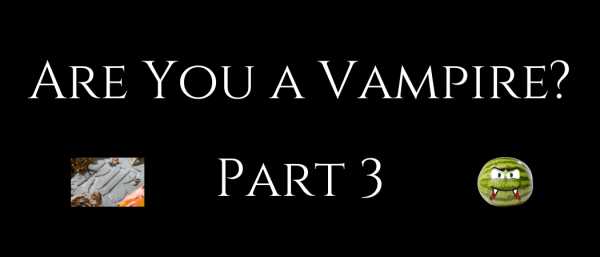
 Thank you, dear readers, for coming on this journey with me. This is the third in a three-part series on determining if you or someone you know is a vampire. In the first part, we explored ways that could still be relevant now. In Part 2, we delved into several old wives’ tales and superstitions. Now, here we are in Part 3. This final part consists of pointers and something extra: vampire animals.
The pointers are a summary of sorts. Things to make sure not to have happen to you or your friends and loved ones. If any of these things do happen, then we’ll need to explore how to combat future possible vampirism and in extreme cases, how to destroy a vampire. Those ideas will be addressed in a future series. For now, I will say, do not approach a suspected vampire and for the love of all things good, don’t try to destroy anyone.
Remember my suggestion from Part 2: Be kind to everyone. And also, don’t kill.
Part 3: Pointers.
Be sure not to die a violent death.
Make sure no animals, particularly cats, jump over your grave before you get there.
No untimely deaths due to accidents or suicide.
Do not die alone or unseen.
Part 3 Extra: Vampire Animals.
You read that right: Vampire Animals were (are) a thing.
Dogs, cats, horses, chickens, sheep, and even snakes could become vampires. Remember the grave jumping cat from before? Not only would the person whose grave it was become a vampire, the cat would, too!
Also, just because you don’t have pets doesn’t mean you’re safe. Plants could also turn, particularly pumpkins and melons. I recall such an instance from when I first started dating my husband, back in 1999. He went out of town for a week, and I checked his mail and watered the plants while he was gone. I hadn’t noticed the watermelon in the sink for a few days. Eventually, it became evident that something rotten lurketh. Pretty sure that watermelon became a vampermelon. Little did I know at the time…
Plants had been known to move, make noises and even bleed if kept in the house too long.
And, if you are sitting smugly thinking you are safe because you have neither pets nor plants, wrong again. Tools were also known to turn. Particularly those that had gone unused for too long.
I kind of sense a theme here…
Anyway, that’s a fairly thorough exploration of all the ways a human (or animal or plant or tool) might become a vampire. After that investigation whattaya think:
Are you a Vampire?
Sources and Notes:
Melton, J. Gordon. The Vampire Book: The Encyclopedia of the Undead. Detroit: Visible Ink, 1994
The ideas were found in The Vampire Book: The Encyclopedia of the Undead in the following sections:
Greece, Vampires in (pp. 272-278)
Gypsies, Vampires and the (pp. 278-282)
Romania, Vampires in (pp. 512-520)
Russia, Vampires in (pp. 524-527)
Scandinavia, Vampires in (pp. 539-541)
Slavs, Vampires Among the (pp. 559-564)

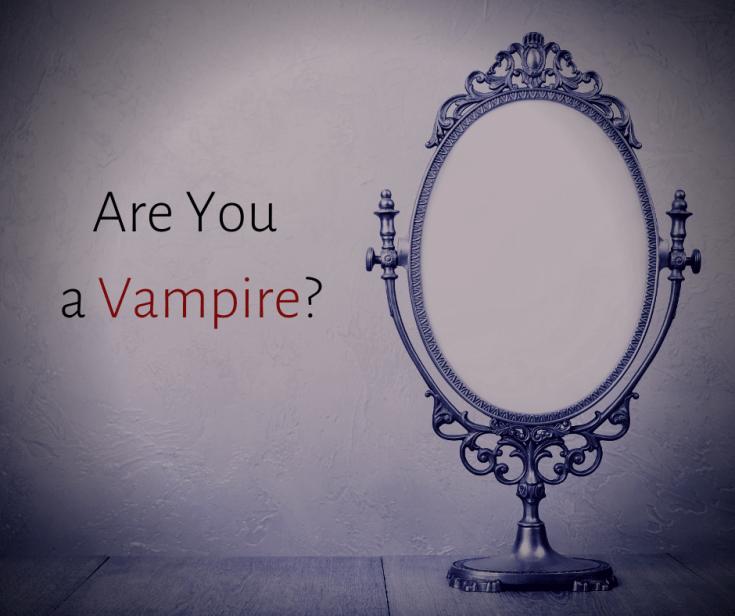 Are you sure?
While perusing my very well used copy of The Vampire Book: The Encyclopedia of the Undead, by J. Gordon Melton, PhD, to learn about various vampire mythologies, one thing struck me: It used to be very easy to be suspected of being a vampire or to have the potential to become one.
“Used to be” encompasses a broad swath of time, but generally speaking during the 18th and 19th centuries and primarily, but not exclusively, in Europe. Mass hysteria swept through many countries on the continent, and similar to the witch trials in New England (but occurring more than a century later), people who didn’t follow the social mores of the day often found themselves or their loved ones accused of vampirism. The main difference here is that death didn’t exempt you from accusations. But that’s another story. For now, let’s determine if you or any of your friends and loved ones are, or might be, or might become, a vampire.
Because there are so many ways vampire status could be achieved, I’ve decided to break this into three parts.
Part One: Contemporary Questions.
Are you allergic to garlic; do you do your best to steer clear of it?
What about salt? Does it burn your skin?
Do loud noises offend you? What about thunder–be careful, because it could kill you if you’re a vampire! (This applies mostly to the chiang-shih* of China, but it’s good to be thorough)
What about holy symbols (such as the crucifix)? Do those agitate you?
Can you walk over a threshold without being invited in? If not, well…you know what that means.
Are you able to cross running water? I sure hope so, or else!
Do you find you can only sleep when on your native soil?
So, what do you think? Are you a vampire?
Sources and Notes:
Melton, J. Gordon. The Vampire Book: The Encyclopedia of the Undead. Detroit: Visible Ink, 1994
The ideas listed above were found in The Vampire Book: The Encyclopedia of the Undead in the following sections:
Greece, Vampires in (pp. 272-278)
Gypsies, Vampires and the (pp. 278-282)
Romania, Vampires in (pp. 512-520)
Russia, Vampires in (pp. 524-527)
Scandinavia, Vampires in (pp. 539-541)
Slavs, Vampires Among the (pp. 559-564)
*There are several spellings of chiang-shih, but The Vampire Book: The Encyclopedia of the Undead uses this spelling. (p. 98)
 She Writes